CALL US

By Rachel Scales, Education solicitor specialising in special educational needs (SEND) tribunals
More children than ever are being educated outside the school system, often for reasons linked to wellbeing, unmet special educational needs, or a breakdown in the relationship between a child and their school. For many families, this is not a straightforward choice but a response to circumstances that feel increasingly difficult to manage. This article explains why numbers are rising and sets out the different legal routes for educating a child out of school, helping parents understand what applies to their family and where responsibility sits.
Sky News recently reported that the number of children who were educated at home in 2024/25 had risen by 15%.
Figures published by the Department for Education (DfE) show a total of 175,900 children in England were electively home educated at some point during the 2024/25 academic year; up from 153,300 the year before. In the autumn term of 2025 alone, 126,000 children were being educated at home – out of about nine million school-eligible youngsters.
Of that 126,000, one in six (16%) cited mental health as the main reason, while 12% were home educated for “philosophical or preferential” reasons.
Experts say that parents are withdrawing their children with mental health or learning difficulties because they cannot get the support they need. Of those educated out of school, one in six (16%) required special educational needs and disabilities (SEND) support, while 7% had an education, health and care plan (EHCP). Many parents report that withdrawing their child from school was not a positive choice but a “last resort” due to school refusal, bullying, or failure to secure a suitable school place.
Jo Hutchinson, co-director for early years and wellbeing at the Education Policy Institute (EPI), said: “It is deeply concerning that the number of children in elective home education continues to climb. We need to ensure children with SEND and mental health difficulties feel they belong in the mainstream system, while also securing adequate specialist places for those with the most complex needs.”
Other reasons for the increase include:
- Post-Pandemic Shift: Many families that began homeschooling during the pandemic lockdown continued to do so, finding it a more suitable, flexible, and safer alternative to traditional classrooms.
- Lack of School Resources: Insufficient funding and staff for special needs, alongside overcrowded classrooms, have weakened confidence in the traditional system.
- Safety Concerns: Bullying, both in-person and online, has become a major factor for parents taking children out of school.
There are three main ways this can be delivered and there are significant differences, legally speaking. These are:
- Elective home education (EHE)
- Education other than in school or college (EOTISC – sometimes called EOTAS)
- Interim education under s19 of the Education Act
Elective home education (EHE)
Often referred to as “home-schooling”, Elective Home Education (EHE) is when parents choose to educate their school-age children at home or in another non-school setting. They take full responsibility for providing a suitable, full-time education instead of enrolling them in traditional school.
Parents should notify the school of their decision to withdraw the child. In the case of a child at a special school the parents need the permission of the LA before home-schooling.
EHE is a parental choice, which is distinct from situations where education outside school is necessary due to illness. It allows families to design learning to suit the child’s needs.
Education can happen at home, in community settings, or through online platforms, with parents potentially using tutors or other resources. Parents must ensure the education is suitable, and the LA can take action if it is concerned that you are not doing this.
Parents become responsible for all educational provision, even if there’s an EHC Plan. The EHC Plan continues but the LA does not need to fund the provision, it just needs to review the Plan once a year.
Parents can change their mind at any time.
Elective home education: Guide for parents
Education other than in school or college is only available to children or young people with EHC Plans and refers to alternative educational provisions for children with complex needs who cannot attend mainstream or special schools. It’s a framework to ensure students with specific barriers, such as anxiety or trauma, receive suitable education outside traditional settings.
Under s61 of the Children and Families Act, EOTISC can only be granted if it would be “inappropriate” for provision to be made in a school or college. That means any school or college, so it can’t be done simply because there are no places available in a suitable setting – the existence of a suitable setting rules this out.
Examples of the provision include: Home tutoring, online schooling, hospital schooling, or tuition centres.
Key features of EOTISC:
- EOTISC is only used for an arrangement that is intended to be long-term – whilst there might be an intention to eventually transition back to school, this shouldn’t be used as a stop-gap.
- The LA has to fund educational provision. It’s important that all educational provision is clearly set out in section F.
- Parents have limited choice of provider unless they opt to arrange the package themselves through direct payments. Section F can’t specify a provider and usually nothing would be named in section I.
- Children of statutory school age can’t attend full time at a non-school setting. Providers will limit the hours children can attend (usually 2-3 days a week). You can split the week over different providers.
- EOTISC tends to be a heavy administrative burden on parents, even if LA is supposed to be arranging the package. There are often delays in commissioning or replacing providers.
Interim education under s19 of the Education Act
Section 19 of the Education Act 1996 places a duty on Local Authorities (LAs) to arrange suitable education for compulsory-school-age children who are not receiving an education for any reason. Common reasons include permanent exclusion, illness, emotionally-based school avoidance, or no school place being available.
Interim education, as its name suggested, is not intended to be permanent. If the interim education becomes long-term, it should transition into EOTISC.
The education provided should be “full-time” unless it is not in the child’s best interests due to physical or mental health. Full-time, however, is not defined. Individual tutoring is usually considered to be more intense than school, so this can be condensed into a shorter time.
Parents have very little choice in how the education is provided – if it’s reasonably practical for the child to access it, it will be “suitable” under this section, even if it would be unlikely that a Tribunal would consider it suitable to be named in an EHC Plan. LAs can e.g. arrange for tutoring, offer online provision or offer a place at a pupil referral unit.
Educational freedom for families
None of these routes is simple. Each comes with trade-offs around funding, flexibility, and administrative burden, and what works well for one child may be unsuitable for another.
Michelle Zaher, co-director of the non-profit Educational Freedom, which provides home education information and support for families said: “Most of the families we support didn’t set out to home educate. They were forced into it because their child was struggling, unsupported, or traumatised by their experience at school.”
A Department for Education spokesperson said: “Every child deserves the chance to get on in life, and we believe that no child’s background should determine their success. In the vast majority of cases, children achieve and thrive best in schools. But parents do have the right to choose to educate their children at home, where that is suitable and in the child’s best interests.”
Children’s Wellbeing and Schools Bill
The new Children’s Wellbeing and Schools Bill is legislation on the horizon that has been proposed to strengthen child protection, improve social care, and raise educational standards by better integrating services, and amongst other things, supporting vulnerable children to ensure no child falls through gaps in support.
A Department for Education spokesperson said: “As part of our Children’s Wellbeing and Schools Bill, we are introducing Children Not in School registers to help local authorities identify those children who are not receiving a suitable education and to take action to support them to improve their life chances.
“We are tackling barriers to school attendance, including through expanding access to mental health support teams in all schools and making sure more children with SEND can achieve and thrive at their local school alongside their peers – including investing at least £3 billion to create more specialist places.”
Currently at the report stage in the House of Lords, the Bill is progressing through Parliament and is now expected to become law in 2026.
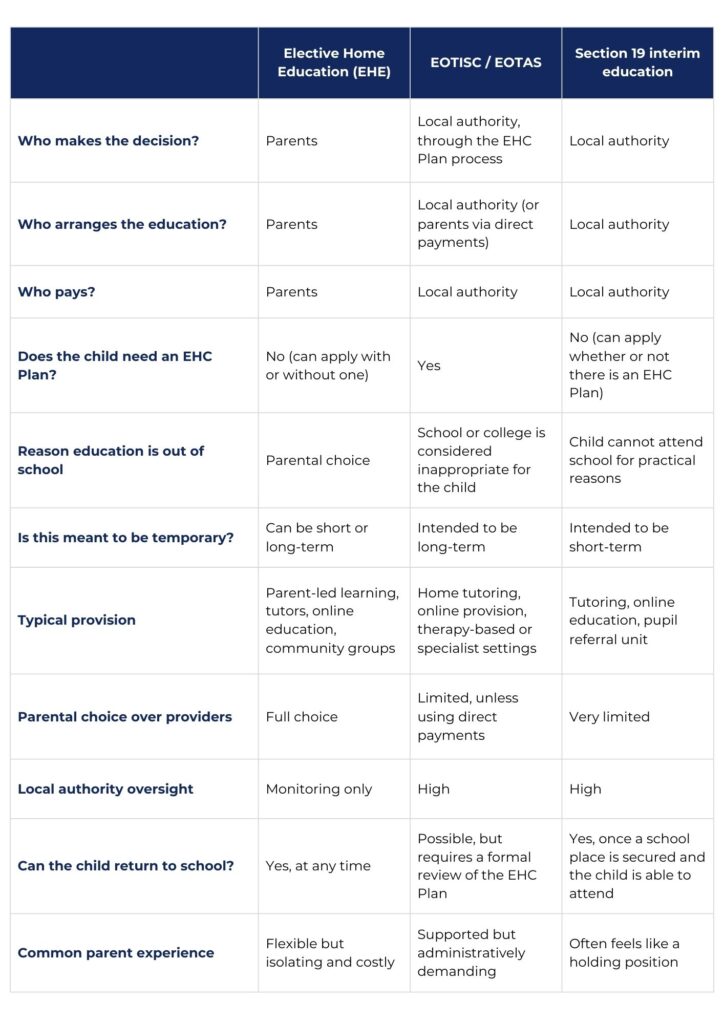
Comparing the options for children educated out of school
A simple takeaway for parents
- If you chose to educate your child yourself → EHE
- If school is formally considered unsuitable and your child has an EHC Plan → EOTISC
- If the council stepped in because your child could not attend school temporarily → Section 19
Frequently asked questions
Do I have to inform the school if I decide to home educate?
You should notify the school in writing that you are withdrawing them for elective home education. The school will then inform the local authority. If your child attends a special school, you will need the local authority’s permission before withdrawing them.
Will the local authority help fund home education?
Not usually. If you choose elective home education, you are responsible for arranging and paying for your child’s education. Even where a child has an Education, Health and Care Plan, the local authority does not have to fund educational provision while the child is electively home educated.
What is the difference between EHE and EOTISC?
The key difference is who holds responsibility.
Elective home education is a parental choice, with parents taking full responsibility for provision.
EOTISC applies where the local authority accepts that attending any school or college would be inappropriate and must therefore arrange and fund education outside a school setting as part of an EHC Plan.
Can my child have an EHC Plan and still be home educated?
Yes. A child can have an EHC Plan and be electively home educated. However, parents remain responsible for providing education, and the local authority is only required to review the plan annually, not to fund the education.
My child is not attending school due to anxiety or illness. Which option applies?
This often falls under section 19 interim education, where the local authority has a duty to arrange suitable education while your child cannot attend school. If the situation becomes long-term, it may need to transition into EOTISC, and your child will need an EHC Plan.
Does “full-time education” mean the same hours as school?
Not necessarily. The law does not define full-time education by hours. One-to-one tuition is often considered more intensive than classroom learning, so fewer hours may still be regarded as suitable, particularly where a child’s health or wellbeing is a factor.
Can the local authority insist my child return to school?
If you are providing suitable elective home education, the local authority cannot force your child back into school. However, if they believe education is not suitable, they can take steps to intervene, including issuing a school attendance order.
What happens if my child is in the wrong category?
This can lead to gaps in support, confusion about funding, or unrealistic expectations being placed on parents. It is important to clarify whether your situation is EHE, EOTISC, or section 19, as each carries different rights and responsibilities.
Is educating a child out of school always a parental choice?
No. Many families report that educating their child out of school was a last resort after unmet needs, school refusal, or lack of suitable placements. The legal framework applied does not always reflect how the situation arose.
Are the rules likely to change?
Proposed reforms under the Children’s Wellbeing and Schools Bill include new registers for children not in school and increased oversight. While parents will retain the right to home educate, local authority involvement and monitoring are expected to increase.
Rachel Scales is an education solicitor specialising in special educational needs (SEND) tribunals, with years of experience supporting families whose children have struggled to secure the support they deserve. Well known for her expertise in SEND tribunals, Rachel provides straightforward, compassionate advice to parents.
Rachel Scales
Scott-Moncrieff & Associates Ltd
Email [email protected]
Phone: 020 3972 9011