CALL US

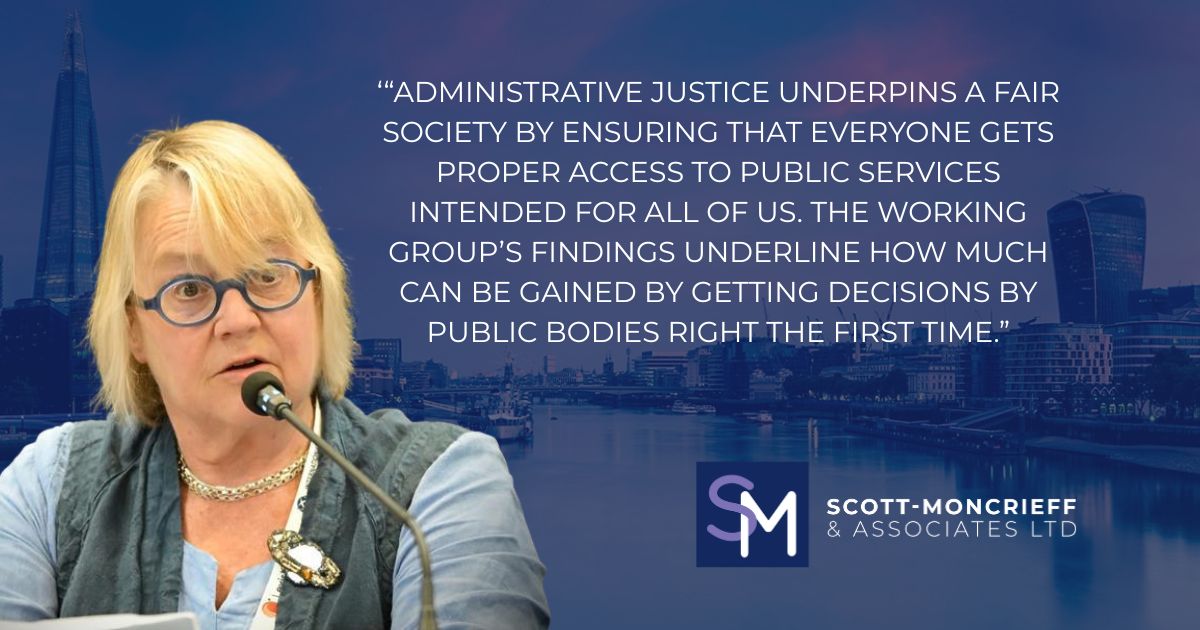
For the past 3 years, Lucy Scott-Moncrieff has chaired a working group of the Administrative Justice Council – the body that advises ministers and judges – exploring the barriers faced by individuals seeking to challenge decisions made by public bodies.
The report is published at a time when the justice system is experiencing serious delays due to the number of cases increasing (government figures for the first quarter of 2025 show the number of cases received by tribunals was 11% higher than in the previous year) and the length of time taken to resolve cases is also increasing – some tribunals can extend as long as 50 weeks. Hundreds of thousands of people are using tribunals every year to challenge decisions on matters such as special educational needs and disability, benefits assessments, immigration and asylum, healthcare and housing.
The working group has concluded that this number could be cut by improving initial decision-making to avoid the growing number of disputes and that poor decision-making by public bodies causes ‘avoidable disputes’ that put ‘systemic strain on tribunals, charities and public services’. Furthermore, it can also ‘significantly drive up the cost of legal advice and services due to increased demand for legal aid and potential challenges to those decisions.’ This creates a vicious cycle where inadequate initial decisions lead to more complex and costly legal processes.
‘By far the most efficient and cost-effective way of removing barriers to justice would be to improve the quality of administrative decision-making so that the need for a challenge to secure justice does not arise in the first place.’
The working group heard evidence from legal advisers who suggested that the system ‘is currently stacked in favour of the [Home Office] and vulnerable appellants are at a huge disadvantage, particularly when unrepresented, but even if they have legal representatives’.
The report also highlights the ‘many failed opportunities’ that the Department for Work and Pensions has to correct decisions that are eventually overturned by the tribunal.
Recommendations
The working group presented 11 recommendations, which included:
- Addressing the root causes of these issues through better training, improved processes, and clearer communication would help reduce the volume of legal challenges and ultimately lower costs.
- Opportunities for appellants and their advisers to give feedback to the public bodies making faulty decisions, so that those bodies are aware of the human and financial cost of poor decisions and that the other services have an opportunity to express their views.
- Increased funding for the advice sector.
- Better coordination between services.
- Embedding of legal advice in community settings, such as libraries and GP surgeries.
- Collaboration between the claimants and respondents to minimise delay and ensure cases are fully prepared by the first hearing.
- Increased collaboration between ombudsman schemes and tribunals.
The report also highlighted the need for clear guidance on tribunal processes and ombudsman schemes, in plain English and translated into other languages. It also calls for increased funding, including for legal aid.
Speaking at the report launch, Lord Justice Dingemans, the senior president of tribunals and chair of the Administrative Justice Council, said: ‘The report is for everyone who plays a part in the system – appellants, respondents, advice providers (who are particularly important in tribunals), ombudsmen, the judiciary and government’. He hopes the ‘succinct and clear’ recommendations will be reflected on by all those with the power to bring them into force.
Lucy Scott-Moncrieff commented, “Administrative justice underpins a fair society by ensuring that everyone gets proper access to public services intended for all of us. The working group’s findings underline how much can be gained by getting decisions by public bodies right the first time. Once a decision is challenged at a tribunal or ombudsman service, improved administrative justice should not only reduce backlogs, but also ensure a level playing field, so that everyone, including those in difficult circumstances, obtains a just outcome.”